How to Sell on Walmart Marketplace: The Complete Guide
24th April 2026
If you want to know how to sell on Walmart Marketplace as an international brand, the first thing to know is this: the process is more accessible than most brands assume, and the opportunity is more urgent than most brands realise.
This guide covers the practical reality, what Walmart Marketplace is, how international brands qualify and onboard, how fulfilment and advertising work, and where the complexity genuinely lies. We will be direct about where things are straightforward and where they are not, because the brands that struggle to sell on Walmart Marketplace are almost always the ones that were not told the truth at the outset.
One note before we start: this guide is intentionally a starting point, not the complete picture. At the end, we point you to IBG’s Walmart Opportunity Playbook – a free resource that goes considerably deeper on every topic covered here, and several that this guide deliberately holds back.
What Is Walmart Marketplace?
Walmart Marketplace is the third-party selling platform embedded within Walmart.com – America’s second-largest e-commerce destination. Independent brands list products directly on the platform alongside Walmart’s own retail inventory, paying a referral fee on each sale – structurally similar to Amazon, but serving a meaningfully different customer.
Walmart’s customer base skews towards family households, everyday essentials, and value-conscious purchasing across home, health, food, and apparel. Brands already on Amazon consistently report finding an incremental customer on Walmart Marketplace – not a different quality of buyer, but a genuinely different buyer. Beyond e-commerce, Walmart operates over 4,600 US retail stores, and strong marketplace performance creates real pathways into that retail estate for international brands with longer-term US ambitions.
Can UK and International Brands Sell on Walmart Marketplace?
Yes! But, the path involves more steps than selling on Amazon. The central question for non-US brands is how to sell into America without a US legal entity, bank account, or tax registration. The answer is through Merchant of Record (MoR) and Importer of Record (IoR) arrangements, where a US-based entity takes on the legal and tax obligations of US commerce on your behalf. With the right partner, this removes the single biggest structural barrier to international market entry.
Beyond the legal layer, Walmart Marketplace applies eligibility criteria that Amazon does not. Applications are reviewed, not automatically approved. Category compliance requirements across health, food, cosmetics, and electronics must be navigated correctly before any listing goes live. Showing up unprepared creates delays that take months to resolve. None of this is insurmountable – but it is not a DIY exercise.
Why Walmart – and Why Now?
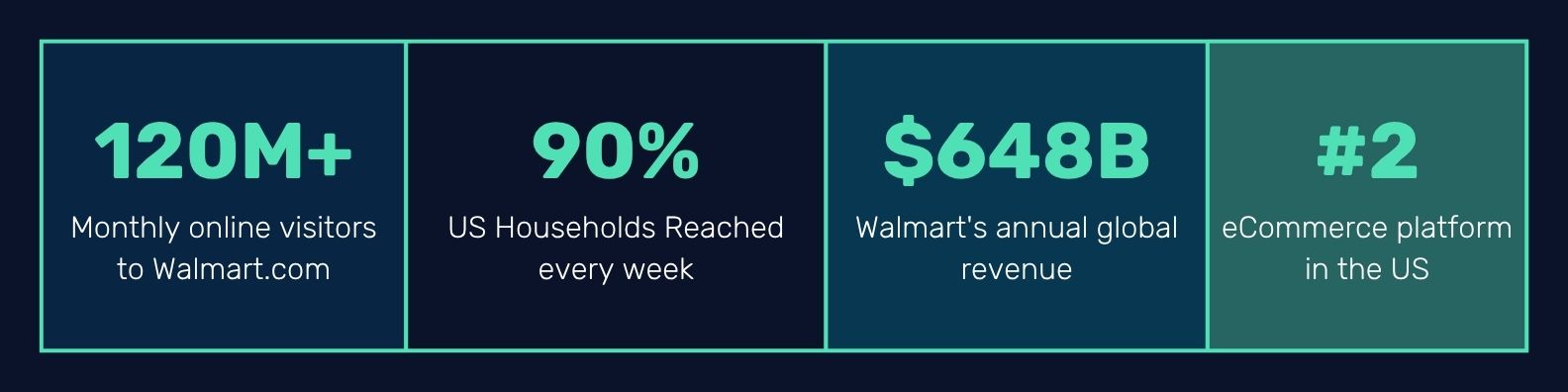
The commercial case for Walmart as a US entry point rests on three things that are simultaneously true and time-limited.
The scale is real
Walmart Marketplace reaches 120 million online shoppers every month and touches 90% of US households every week. The $648 billion global revenue figure is not background colour – it represents the logistics, technology, customer trust, and brand equity that marketplace sellers plug directly into. For international brands, this is not a secondary channel experiment. It is an entry point into one of the most valuable consumer markets in the world.
The competitive window is still open
Amazon is a mature, saturated environment. Advertising costs have risen significantly year-on-year, organic ranking is increasingly difficult to establish, and most categories are crowded with brands that have been building their positions for a decade. Walmart Marketplace is an earlier-stage environment – less crowded, with lower cost-per-click and an algorithm that actively rewards new, quality listings. The brands which sell on Walmart Marketplace now are establishing positions that their competitors will spend considerably more to match in two to three years. The window will not stay open indefinitely.
Walmart is actively recruiting brands like yours
Walmart has made a strategic decision to attract premium, digitally native, and internationally recognised brands to its marketplace. It is investing in the tools, partner infrastructure, and seller support to make this happen. Brands entering now are not fighting for attention – they are being courted. That dynamic reflects where Walmart Marketplace is in its maturity curve, and it will not last as the platform scales.
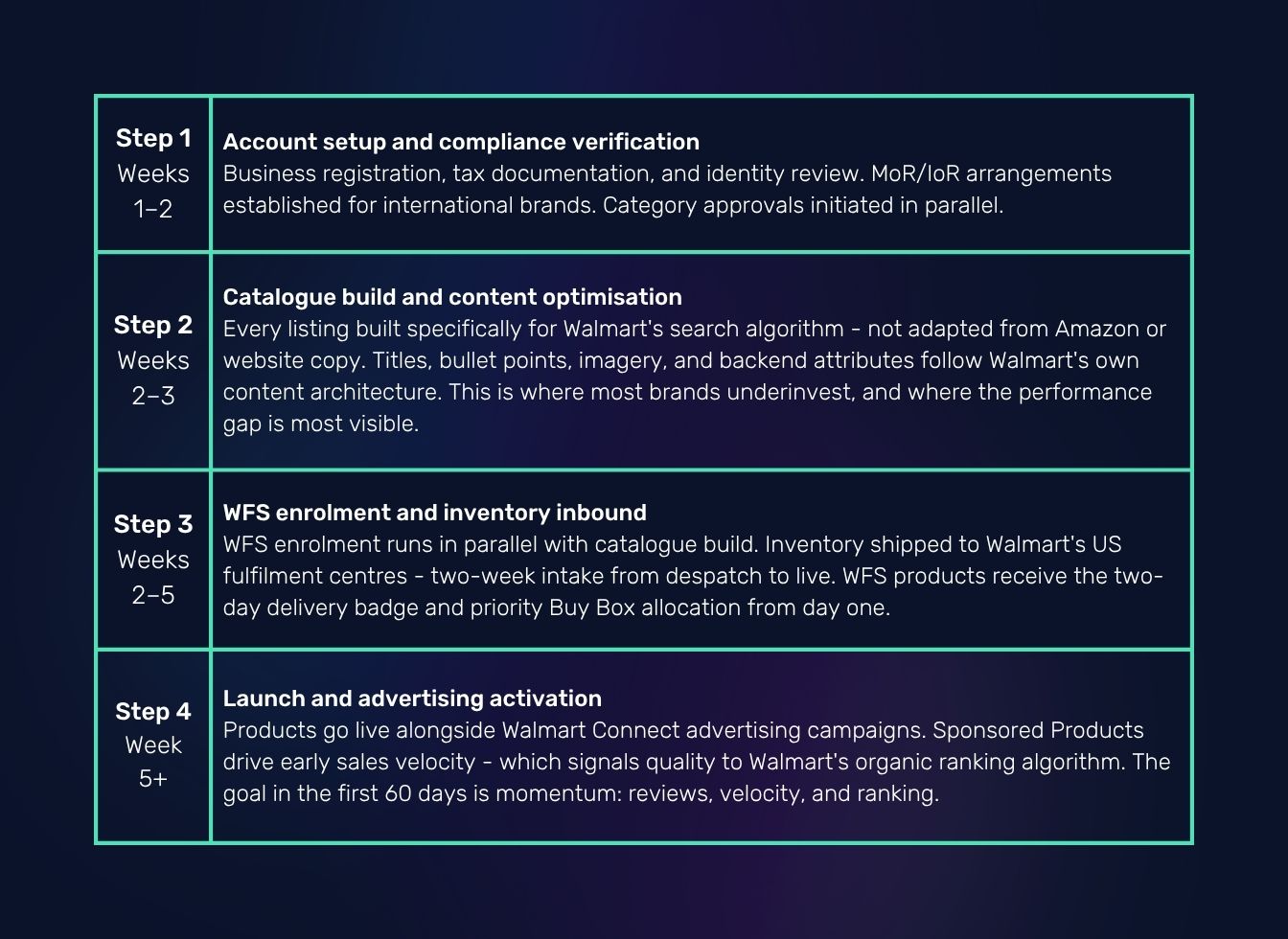
How to Sell on Walmart Marketplace: The Practical Steps
For international brands, the journey from decision to live products typically spans four to eight weeks when executed properly.
Understanding Walmart Fulfilment Services (WFS)
WFS is the infrastructure that makes Walmart commercially viable for international brands. Without it, to sell on Walmart Marketplace means self-managing cross-border logistics – customs clearance, domestic warehousing, last-mile delivery, and returns – all from outside the US. With WFS, Walmart handles all of it. Orders are picked, packed, shipped, and returned through Walmart’s own network.
WFS-enrolled products receive the nationwide two-day delivery badge, priority Buy Box positioning, and positive signals within Walmart’s search ranking algorithm. For international brands, it is not one fulfilment option among several. It is the only option that makes the channel algorithmically competitive from launch.
Plan for it early. WFS has specific packaging, labelling, and carton requirements that must be met before Walmart accepts inbound shipments, and lead times average two weeks from dispatch to live. Brands that treat WFS as an afterthought often find themselves live on the platform but unable to fulfil – a position that is genuinely difficult to recover from.
Advertising on Walmart: What’s Different From Amazon
Walmart Connect shares surface-level similarities with Amazon Advertising – sponsored products, keyword bidding, campaign structure – but the underlying logic is different in three ways that matter:
- Attribution works differently. Amazon’s ACoS model does not translate directly. Walmart Connect uses different measurement periods and conversion definitions, and brands that optimise for Amazon-style ACoS targets consistently misread their Walmart campaign performance.
- The competitive landscape is less mature, which is an advantage. Cost-per-click is lower than Amazon across most categories. Share of voice is more achievable. Brands with modest budgets can establish genuine visibility that is increasingly difficult on Amazon without significant spend.
- Early advertising builds long-term organic ranking. Walmart’s algorithm weights sales velocity heavily in determining where products appear organically. Launch advertising is not just about early sales – it is setting the organic baseline that determines visibility six months from now.
Where Brands Go Wrong on Walmart Marketplace
Three failure patterns appear consistently across international brand launches on Walmart Marketplace.
The most common is launching before the foundations are in place – going live without WFS enrolled, a proper advertising strategy, or catalogue content built for Walmart’s search architecture. The result is a live account with poor visibility and no mechanism to build the sales velocity that would improve it. Recovering from a weak launch is significantly harder than building a strong one.
The second is treating Walmart as an Amazon extension. The operational logic, content requirements, advertising attribution, and compliance frameworks are all different. Brands that import their Amazon approach consistently underperform and draw the wrong conclusion – that Walmart does not work for their category. Usually, it means Walmart does not work with an Amazon playbook.
The third is underestimating compliance timelines. Category approval requirements for regulated categories take time and require the right documentation. Brands that do not map the compliance process before starting routinely find their launch delayed by four to eight weeks at a stage that could have been cleared in advance.
Is Selling on Walmart Marketplace Right for Your Brand?
Not every brand is at the right stage for Walmart. These are the four questions worth answering honestly before committing:
- Does your product work in the US market? Premium brands perform well on Walmart – particularly in health, beauty, home, and apparel – but the value proposition needs to translate to an American consumer with no prior brand awareness.
- Can you support the inventory commitment? WFS requires physical stock in Walmart’s US fulfilment centres. Consistent replenishment and demand planning – especially around peak periods – are non-negotiable.
- Do you have the bandwidth to manage the channel – or a partner who can? Walmart rewards active management. Brands that launch and step back see momentum flatten quickly.
- Is the US a priority in the next 12–24 months? If yes, Walmart is one of the most capital-efficient entry points available – and the cost of establishing a position is lower today than it will be in two years.
What Good Walmart Partnership Looks Like
The quality of the partner relationship on Walmart is unusually determinative of outcomes. Because the platform involves compliance, fulfilment logistics, content architecture, and advertising strategy all running simultaneously, having the wrong partner does not just slow you down – it actively damages the channel. The difference between a partner who knows Walmart and one who does not is not measured in weeks. It is measured in whether the channel works at all.
At minimum, expect: end-to-end compliance and onboarding management, catalogue build native to Walmart’s search architecture, WFS onboarding and ongoing inventory management, a structured Walmart Connect advertising strategy, and performance reporting that tells you what is happening and why – not just a dashboard login.
Beyond the operational baseline, look for one specific credential: formal recognition by Walmart itself. Walmart’s International Strategic Partner programme is a small, invitation-only designation for agencies formally accredited by Walmart on commercial performance and operational standards. There are are small amount globally. Working with one provides direct access to Walmart’s internal teams, faster resolution of platform issues, platform intelligence ahead of the broader market, and commercial standing that unaccredited agencies simply cannot offer.
This guide is the starting point. The Playbook is the full picture.
Infinity Blue Group’s Walmart Opportunity Playbook covers everything this guide introduces – in full strategic and operational depth. The market entry case, the commercial framework, all four failure points in detail, the end-to-end management model, and what Walmart International Strategic Partner status means for the brands we work with. Free to download. Written for brand decision-makers, not platform specialists.